
Branding and Website Design Direction for Elevated Aesthetics
Your website is beautiful and you love how it looks. But you know your website is getting absolutely ZERO traffic from Google. If that sounds familiar, I'm really glad you found this post because I want to talk about something that doesn't get explained clearly enough: SEO friendly web design isn't a feature you add to your website after it's built. It's either baked into the build or it isn't, and most of the time? It isn't.
I've been building websites for therapists and health practitioners for over 7 years and honestly the number of gorgeous, expensive, completely un-rankable websites I've seen would make you want to cry a little. Not because the designers were bad. But because web design and SEO require each other, and a lot of designers just aren't thinking about both at the same time.
So this post is going to walk you through what SEO friendly web design actually looks like in practice, what goes wrong when the two aren't considered together, and what to look for when you're vetting a web designer so you don't end up with a beautiful site that nobody ever finds.
Okay but what does "SEO friendly" even mean
SEO friendly web design means your site is built in a way that makes it easy for Google to crawl, understand, and rank your pages. I know that still sounds like jargon so let me make it more concrete.
Google sends little bots to visit your site. Those bots read your pages and try to figure out what each page is about, how your pages relate to each other, how fast everything loads, whether the experience is good on a phone, and about a hundred other things. Then Google uses all of that to decide how to rank you when someone searches for something you offer. SEO friendly web design just means your site makes that process easy instead of hard.
Clean code, logical structure, fast loading, clear headings, images that are labeled properly. All of that is web design and SEO working together.
The problem is when someone designs a site thinking only about how it looks, those things get ignored. Not on purpose. Just because aesthetics and SEO require different thinking and most designers aren't holding both in their head at once.
Why website design and SEO have to happen at the same time
Here's the thing nobody tells you when you're hiring a web designer: a lot of the decisions that impact your SEO are made during the build. By the time your site launches, a lot of it is already locked in.
So when an SEO person comes along six months after your site goes live and says "we need to fix some things before we can really move the needle," what they're often describing is undoing decisions that were made during the design process. Extra time, extra cost, sometimes a partial rebuild and it’s definitely not fun.
The stuff that gets missed most often when design and SEO aren't thought about together:
Page speed. If your designer loaded your site with heavy fonts, large uncompressed images, and a theme that wasn't built with performance in mind, your site is probably slow. And Google uses page speed as a ranking signal. A slow site is going to be harder to rank no matter how good your content is, full stop.
Heading structure. Every page should have one H1 that clearly tells Google what that page is about, then H2s for the main sections, H3s for anything nested under those. When a designer builds pages based on how things look rather than how they're structured, you end up with a mess of headings that makes complete sense visually and makes zero sense to a search engine.
Site architecture. How your pages are organized, how they connect to each other, which pages link to which other pages. This stuff matters a lot for SEO and it's almost entirely a design and development decision. A flat site where everything just kind of exists without any clear organization makes it hard for Google to understand what your site is actually about.
Images without alt text. Every image on your site should have a short description that tells Google what it shows. It also matters for accessibility, which honestly should be a priority for any healthcare or wellness practice building a website for clients who may use screen readers. This is one of those things that takes like 30 seconds per image during the build and almost never gets done unless someone is specifically thinking about it.
A layout that falls apart on mobile. Google indexes the mobile version of your site first. If your site looks incredible on a desktop and clunky on a phone, you are going to rank lower. That's just how it works now.
None of this is the fault of people who hired a designer without asking about SEO. You don't know what you don't know. But it is why I want more practitioners to understand this stuff BEFORE they work on any SEO and web design project.
The SEO and web design decisions that actually move the needle
What does good website design and SEO look like when someone's actually doing it right? Here's what I focus on in our SEO-friendly website design services for small business owners and private practices:
Clean, minimal code. Less unnecessary code means faster loading and easier crawling, and some website builders generate so much extra stuff in the background that you're starting with extra weight before you've even thought about content. This is part of why I'm particular about which platforms and themes I build on.
Keyword placement that's built into the structure. Your H1 on every important page should contain the keyword that page is trying to rank for. Your meta titles should be written for real humans and for search engines. The way your pages are structured should reflect the content hierarchy you're trying to create.
Page speed as a non-negotiable. I compress images before uploading, I'm intentional about fonts and scripts, I test load times before anything goes live. These are just part of the process.
Internal linking that's planned from the start. our service pages should link to relevant blog content. Your blog posts should link back to your service pages and to other relevant posts. This tells Google which content is important and helps authority flow across your site. It genuinely makes a difference and it's one of those things where doing it from the start is so much easier than retrofitting it.
URLs that make sense. Clean, readable URLs that include keywords are better for SEO and better for users. Something like yoursite.com/services/therapy-website-design tells both Google and humans a lot more than yoursite.com/page?id=4892.
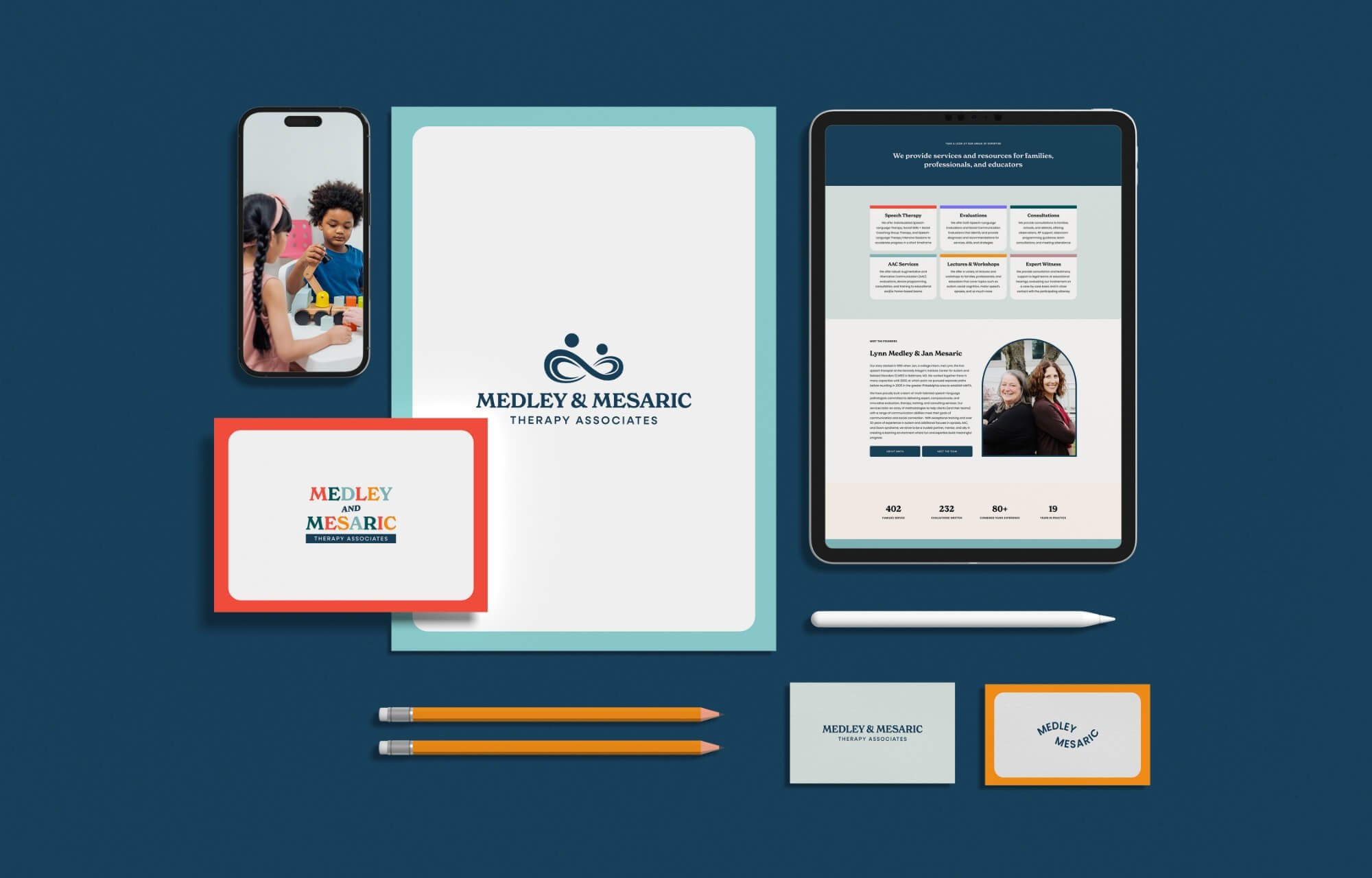
Therapy Branding and Website Design for a Speech Therapist Practice
What I see go wrong with therapy and wellness websites specifically
I work almost exclusively with therapists, mental health practices, nutritionists, and functional medicine practitioners so I've got a pretty specific view of where things tend to fall apart in this niche.
The most common one is choosing a website platform based on how it looks in demos without understanding what it can and can't do for SEO. Some platforms are genuinely better for search optimization than others, and that gap becomes really significant if you're building out a content strategy, running multiple locations, or trying to rank in a competitive market. I have a full post comparing options specifically for therapists if you want to dig into that, you can find it here.
The second one is publishing a bunch of pages with no keyword strategy behind them. Every page on your site should be trying to rank for something specific. Your homepage, your about page, each of your service pages. When there's no strategy, you end up with content that might be genuinely helpful but isn't targeted at anything, so it doesn't rank for anything either.
The third is building a beautiful site and then basically leaving it alone forever. Google pays attention to whether your site is being updated. A static site that hasn't changed since 2023 is going to have a harder time than a site that's publishing relevant, well-optimized content on a regular basis. This is where blogging actually matters for SEO, not just as a place to share thoughts, but as an ongoing signal to search engines that your site is active and worth paying attention to.
And the fourth is completely ignoring local SEO. If you see clients in person, or you want to attract clients in a specific state or city, you need location signals in your content. Your Google Business Profile needs to be set up and maintained. Your metadata should include location where it's relevant. This is one of the areas where a lot of practices are genuinely leaving traffic on the table.
The technical side of SEO and web development (without the headache)
I know "technical SEO" sounds intimidating but for most small to mid-size practices the baseline stuff isn't that complicated. Here's what every site should have sorted before you start driving traffic to it.
HTTPS. Your site should be loading securely over HTTPS, not HTTP. This is a basic security standard and a ranking signal. Most platforms handle this automatically now but it's worth confirming.
An XML sitemap. This is basically a map of your site that helps search engines find all your pages. Most platforms generate this for you. You just need to make sure it's been submitted to Google Search Console.
A robots.txt file that actually makes sense. This file tells search engines which pages to crawl and which to skip. A misconfigured one can accidentally block your whole site from being indexed and I have genuinely seen this happen to a practice that had been wondering for months why their new site wasn't getting any traffic. So worth checking.
Redirects when URLs change. If you ever change a page URL, you need to redirect the old URL to the new one. Otherwise you lose whatever rankings and link equity that page had built up. This is especially important during a redesign.
For practices that are growing fast, expanding to multiple locations, or building a more complex content strategy, this is where the platform and developer you choose starts to really matter. WordPress gives you full control over all of this in a way that some other platforms don't, which is why I use it for larger or more SEO-intensive projects. I talk about when that actually makes sense over in my post on website design for mental health professionals.
Questions to ask a web designer before you hire them
If you're hiring someone to build or redesign your site, here's what I'd actually want to know before signing anything.
"Do you optimize for page speed during the build?" A designer who understands SEO will have a clear answer and be able to explain how they approach it. If the response is vague or they say something like "that's more of an SEO thing," that tells you something.
"How do you handle heading structure across the site?" They should know what H1s and H2s are and why the hierarchy matters. Ask about the platform they build on and why they recommend it for your situation, because the platform matters more than a lot of people realize. Ask whether you'll be able to update the site yourself after launch, because you should not need to hire a developer every time you want to publish a blog post.
"What platform do you build on and why?" The platform matters more than a lot of people realize. Make sure you understand what you're getting into and what the long-term implications are for your content strategy.
"Will I be able to update the site myself after launch?" You should not need to hire a developer every time you want to publish a blog post or update a service page. That's not sustainable.
"Do you set up Google Search Console and Analytics before handoff?" If this isn't part of their process, you're launching blind with no way to track what's working.
"Have you built websites for healthcare or wellness practices before?" There are specific trust signals, HIPAA considerations, and content nuances that come with this niche. A designer who's worked in it will understand those things without you having to explain them.
The honest version of how long this takes
Even a perfectly built, well-optimized site is not going to rank on page one in a month. SEO takes time and anyone who tells you otherwise is selling something.
But the foundation you start with makes a huge difference in how quickly you get there. The practices I work with that are doing well in organic search aren't necessarily the ones with the biggest budgets. They're the ones who started with a well-built site, kept publishing consistent content, and gave it actual time to work. Most of them started seeing meaningful traffic six to twelve months in, and it's kept growing since because the foundation was solid.
And honestly? That's a pretty good deal compared to the ongoing cost of paid ads. A site that ranks well becomes an asset that keeps working for you whether you're seeing clients, on vacation, or in my case, somewhere in Southeast Asia eating very good food.
Let's build something that actually ranks
If you're a therapist, mental health practice, or health and wellness practitioner ready to have a website that's built for both design and SEO from the very beginning, I'd love to hear about your project.
Every website I design and develop has SEO baked in from day one.
Book a strategy call here and let's talk about what your site actually needs!